YDYの博客

一只有理想的菜鸟

minitorch系列记录

MiniTorch是对 torch api的纯Python重新实现,设计简单、易于阅读、容易进行测试和扩充。miniTorch最终的库可以运行Torch代码。

Mycode:

MiniTorch官方文档:

还可以参考:MiniTorch-学习全攻略


module0

Overview

环境

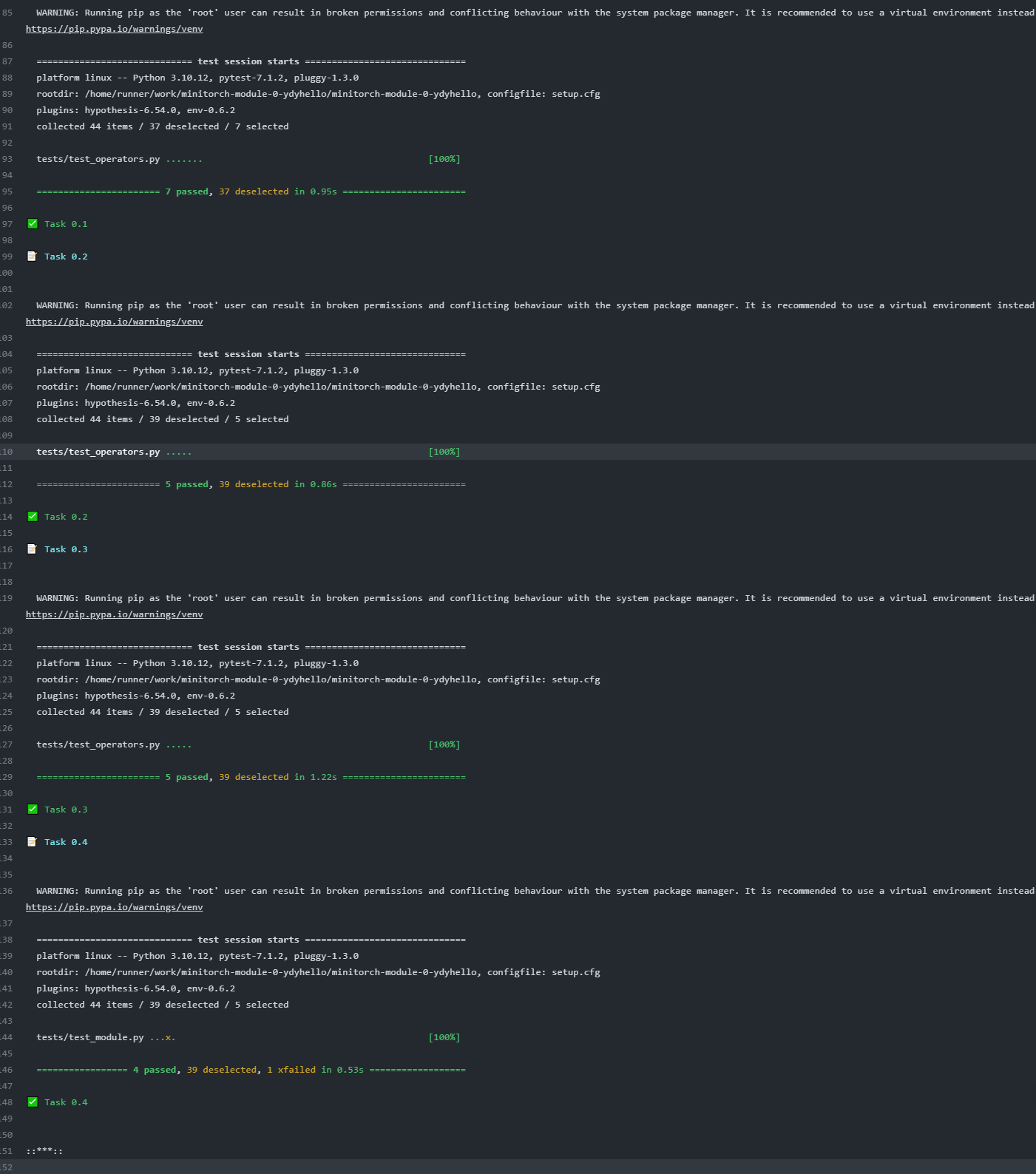
https://blog.csdn.net/ChaoFeiLi/article/details/124760367

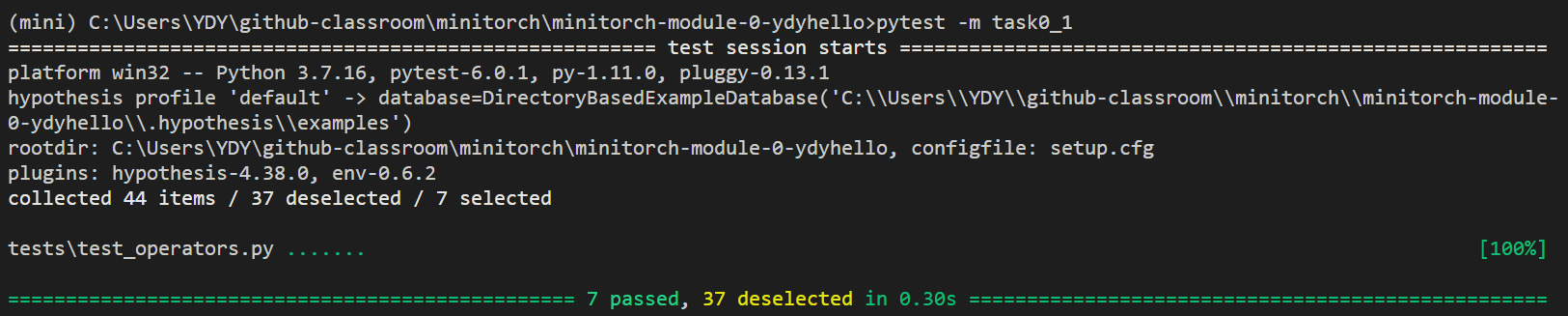
测试一下

1.png

Task 0.1: Operators

1
2
3
4
5
6
7
8
9
10
11
12
13
14
15
16
17
18
19
20
21
22
23
24
25
26
27
28
29
30
31
32
33
34
35
36
37
38
39
40
41
42
43
44
45
46
47
48
49
50
51
52
53
54
55
56
57
58
59
60
61
62
63
64
65
66
67
68
69
70
71
72
73
74
75
76
77
78
79
80
81
82
83
84
85
86
87
88
89
90
91
92
93
94
95
96
97
98
99
100
101
102
103
104
105
106
107
108
109
110
111
112
113
114
115
116
117
118
119
120
121
122
123
124
125
126
127
128
129
130
# ## Task 0.1
#
# Implementation of a prelude of elementary functions.


def mul(x: float, y: float) -> float:
"$f(x, y) = x * y$"
# TODO: Implement for Task 0.1.
return x * y

raise NotImplementedError("Need to implement for Task 0.1")


def id(x: float) -> float:
"$f(x) = x$"
# TODO: Implement for Task 0.1.
return x
raise NotImplementedError("Need to implement for Task 0.1")


def add(x: float, y: float) -> float:
"$f(x, y) = x + y$"
# TODO: Implement for Task 0.1.
return x + y
raise NotImplementedError("Need to implement for Task 0.1")


def neg(x: float) -> float:
"$f(x) = -x$"
# TODO: Implement for Task 0.1.
return -x
raise NotImplementedError("Need to implement for Task 0.1")


def lt(x: float, y: float) -> float:
"$f(x) =$ 1.0 if x is less than y else 0.0"
# TODO: Implement for Task 0.1.
return 1.0 if x < y else 0.0
raise NotImplementedError("Need to implement for Task 0.1")


def eq(x: float, y: float) -> float:
"$f(x) =$ 1.0 if x is equal to y else 0.0"
# TODO: Implement for Task 0.1.
return 1.0 if x == y else 0.0
raise NotImplementedError("Need to implement for Task 0.1")


def max(x: float, y: float) -> float:
"$f(x) =$ x if x is greater than y else y"
# TODO: Implement for Task 0.1.
return x if x > y else y

raise NotImplementedError("Need to implement for Task 0.1")


def is_close(x: float, y: float) -> float:
"$f(x) = |x - y| < 1e-2$"
# TODO: Implement for Task 0.1.
return abs(x - y) < 1e-2
raise NotImplementedError("Need to implement for Task 0.1")


def sigmoid(x: float) -> float:
r"""
$f(x) = \frac{1.0}{(1.0 + e^{-x})}$

(See https://en.wikipedia.org/wiki/Sigmoid_function )

Calculate as

$f(x) = \frac{1.0}{(1.0 + e^{-x})}$ if x >=0 else $\frac{e^x}{(1.0 + e^{x})}$

for stability.
"""
# TODO: Implement for Task 0.1.
return 1.0 / (1.0 + math.exp(-x)) if x >= 0 else math.exp(x) / (1.0 + math.exp(x))
raise NotImplementedError("Need to implement for Task 0.1")


def relu(x: float) -> float:
"""
$f(x) =$ x if x is greater than 0, else 0

(See https://en.wikipedia.org/wiki/Rectifier_(neural_networks) .)
"""
# TODO: Implement for Task 0.1.
return x if x > 0.0 else 0.0
raise NotImplementedError("Need to implement for Task 0.1")


EPS = 1e-6


def log(x: float) -> float:
"$f(x) = log(x)$"
return math.log(x + EPS)


def exp(x: float) -> float:
"$f(x) = e^{x}$"
return math.exp(x)


def log_back(x: float, d: float) -> float:
r"If $f = log$ as above, compute $d \times f'(x)$"
# TODO: Implement for Task 0.1.
return d * 1.0 / x
raise NotImplementedError("Need to implement for Task 0.1")


def inv(x: float) -> float:
"$f(x) = 1/x$"
# TODO: Implement for Task 0.1.
return 1.0 / x
raise NotImplementedError("Need to implement for Task 0.1")


def inv_back(x: float, d: float) -> float:
r"If $f(x) = 1/x$ compute $d \times f'(x)$"
# TODO: Implement for Task 0.1.
return -d / x ** 2
raise NotImplementedError("Need to implement for Task 0.1")


def relu_back(x: float, d: float) -> float:
r"If $f = relu$ compute $d \times f'(x)$"
# TODO: Implement for Task 0.1.
return d if x > 0 else 0.0
raise NotImplementedError("Need to implement for Task 0.1")

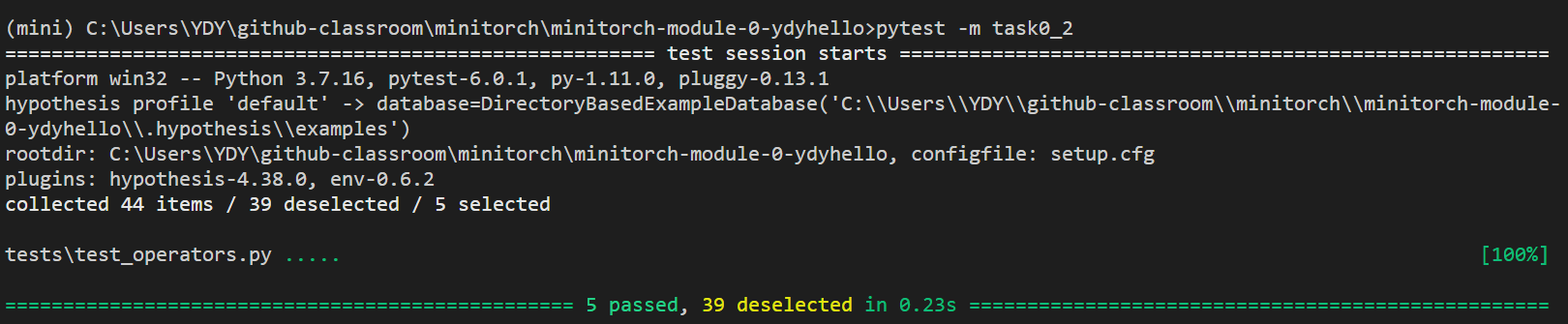
2.png

Task 0.2: Testing and Debugging

1
2
3
4
5
6
7
8
9
10
11
12
13
14
15
16
17
18
19
20
21
22
23
24
25
26
27
28
29
30
31
32
33
34
35
36
37
38
39
40
41
42
43
44
45
46
47
48
49
50
51
52
53
54
55
56
57
58
59
60
61
62
63
64
65
66
67
68
69
70
71
72
73
74
75
76
77
78
79
# ## Task 0.2 - Property Testing

# Implement the following property checks
# that ensure that your operators obey basic
# mathematical rules.


@pytest.mark.task0_2
@given(small_floats)
def test_sigmoid(a: float) -> None:
"""Check properties of the sigmoid function, specifically
* It is always between 0.0 and 1.0.
* one minus sigmoid is the same as sigmoid of the negative
* It crosses 0 at 0.5
* It is strictly increasing.
"""
# TODO: Implement for Task 0.2.
assert sigmoid(a) >= 0.0 # 断言检测大于等于0
assert sigmoid(a) <= 1.0 # 小于等于0
assert_close(1 - sigmoid(a), sigmoid(-a)) # sigmoid(-x) = 1 - sigmoid(x)
assert_close(sigmoid(0), 0.5) # sigmoid(0)接近0.5
assert sigmoid(a + 1.0) >= sigmoid(a) # 递增
#raise NotImplementedError("Need to implement for Task 0.2")


@pytest.mark.task0_2
@given(small_floats, small_floats, small_floats)
def test_transitive(a: float, b: float, c: float) -> None:
"Test the transitive property of less-than (a < b and b < c implies a < c)"
# 如果 a < b 和 b < c 成立,那么 a < c 也应该成立
# 传递律
# TODO: Implement for Task 0.2.
if lt(a, b) and lt(b, c):
assert lt(a, c)
elif lt(a, c) and lt(c, b):
assert lt(a, b)
elif lt(b, c) and lt(c, a):
assert lt(b, a)
# raise NotImplementedError("Need to implement for Task 0.2")


@pytest.mark.task0_2
@given(small_floats, small_floats)
def test_symmetric(a:float, b:float) -> None:
"""
Write a test that ensures that :func:`minitorch.operators.mul` is symmetric, i.e.
gives the same value regardless of the order of its input.
"""
# 对称性
# a*b=b*a
# TODO: Implement for Task 0.2.
assert mul(a, b) == mul(b, a)
# raise NotImplementedError("Need to implement for Task 0.2")


@pytest.mark.task0_2
@given(small_floats, small_floats, small_floats)
def test_distribute(x: float, y: float, z: float) -> None:
"""
Write a test that ensures that your operators distribute, i.e.
:math:`z \times (x + y) = z \times x + z \times y`
"""
# TODO: Implement for Task 0.2.
# z * (x + y) 和 z * x + z * y
# 分配律
assert_close(mul(z, add(x, y)), add(mul(z, x), mul(z, y)))
# raise NotImplementedError("Need to implement for Task 0.2")


@pytest.mark.task0_2
@given(small_floats, small_floats)
# 想不出来其他的了
def test_other(a:float, b:float) -> None:
"""
Write a test that ensures some other property holds for your functions.
"""
# TODO: Implement for Task 0.2.
assert mul(a, b) == mul(b, a)
# raise NotImplementedError("Need to implement for Task 0.2")

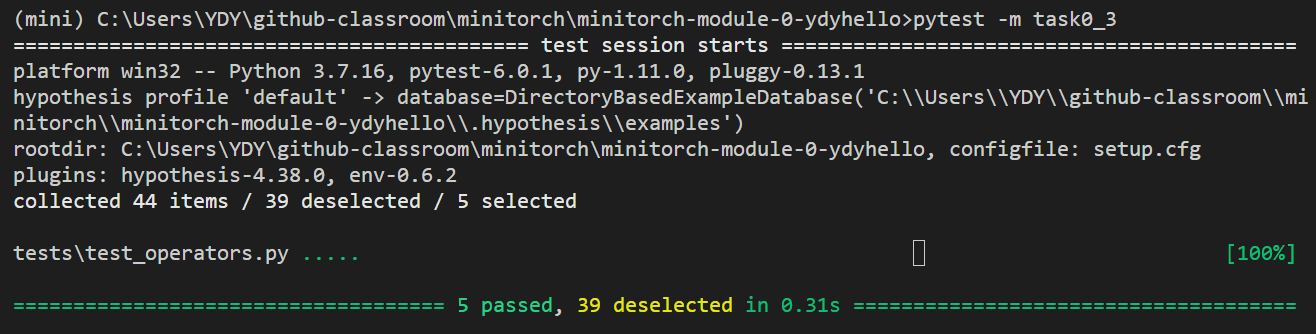
3.png

Task 0.3: Functional Python

1
2
3
4
5
6
7
8
9
10
11
12
13
14
15
16
17
18
19
20
21
22
23
24
25
26
27
28
29
30
31
32
33
34
35
36
37
38
39
40
41
42
43
44
45
46
47
48
49
50
51
52
53
54
55
56
57
58
59
60
61
62
63
64
65
66
67
68
69
70
71
72
73
74
75
76
77
78
79
80
81
82
83
84
85
86
87
88
89
90
91
92
93
94
95
96
97
98
99
100
101
102
103
104
105
106
107
108
109
# ## Task 0.3

# Small practice library of elementary higher-order functions.


def map(fn: Callable[[float], float]) -> Callable[[Iterable[float]], Iterable[float]]:
"""
Higher-order map.

See https://en.wikipedia.org/wiki/Map_(higher-order_function)

Args:
fn: Function from one value to one value.

Returns:
A function that takes a list, applies `fn` to each element, and returns a
new list
"""
# 闭包
# 捕获了传入的 fn 参数,并可以在以后的调用中使用它
# TODO: Implement for Task 0.3.
def myFn(ls: Iterable[float]) -> Iterable[float]:
return [fn(e) for e in ls]
return myFn
# raise NotImplementedError("Need to implement for Task 0.3")


def negList(ls: Iterable[float]) -> Iterable[float]:
"Use `map` and `neg` to negate each element in `ls`"
# TODO: Implement for Task 0.3.
# 将 neg 函数应用到 ls 中的每个元素,以生成一个新的可迭代的序列,其中每个元素都是 ls 中对应元素的相反数
return map(neg)(ls)
# raise NotImplementedError("Need to implement for Task 0.3")


def zipWith(
fn: Callable[[float, float], float], ls1: Iterable[float], ls2: Iterable[float]
) -> Callable[[Iterable[float], Iterable[float]], Iterable[float]]:
"""
Higher-order zipwith (or map2).

See https://en.wikipedia.org/wiki/Map_(higher-order_function)

Args:
fn: combine two values

Returns:
Function that takes two equally sized lists `ls1` and `ls2`, produce a new list by
applying fn(x, y) on each pair of elements.

"""
# TODO: Implement for Task 0.3.
ls = [] # 用于存储 fn 函数应用后的结果
# 使用 zip 函数将 ls1 和 ls2 中对应位置的元素进行配对,然后使用 for 循环遍历这些配对。在循环中,对每一对元素 (x, y) 调用 fn(x, y),将结果追加到 ls 列表中
for x, y in zip(ls1, ls2):
ls.append(fn(x, y))
return ls
# raise NotImplementedError("Need to implement for Task 0.3")


def addLists(ls1: Iterable[float], ls2: Iterable[float]) -> Iterable[float]:
"Add the elements of `ls1` and `ls2` using `zipWith` and `add`"
# TODO: Implement for Task 0.3.
return zipWith(add, ls1, ls2) # 相加
# raise NotImplementedError("Need to implement for Task 0.3")


def reduce(
fn: Callable[[float, float], float], start: float
) -> Callable[[Iterable[float]], float]:
r"""
Higher-order reduce.

Args:
fn: combine two values
start: start value $x_0$

Returns:
Function that takes a list `ls` of elements
$x_1 \ldots x_n$ and computes the reduction :math:`fn(x_3, fn(x_2,
fn(x_1, x_0)))`
"""
# TODO: Implement for Task 0.3.
# start是起始值
# 归约
# 依次应用 fn 函数将序列中的元素合并在一起
def myFn(ls: Iterable[float]) -> float:
# 闭包中并不会修改外部start的值
t = start
for e in ls:
t = fn(e, t) # 使用 fn(e, t) 更新变量 t
return t
return myFn
# raise NotImplementedError("Need to implement for Task 0.3")


def sum(ls: Iterable[float]) -> float:
"Sum up a list using `reduce` and `add`."
# TODO: Implement for Task 0.3.
# 0 是起始值
return reduce(add, 0)(ls) # 从0开始,依次对元素求和
# raise NotImplementedError("Need to implement for Task 0.3")


def prod(ls: Iterable[float]) -> float:
"Product of a list using `reduce` and `mul`."
# TODO: Implement for Task 0.3.
return reduce(mul, 1)(ls) # 累积
# raise NotImplementedError("Need to implement for Task 0.3")
1
2
3
4
5
6
7
8
9
10
11
12
13
14
15
16
@pytest.mark.task0_3
@given(
lists(small_floats, min_size=5, max_size=5),
)
def test_sum_distribute(ls1: List[float], ls2: List[float]) -> None:
"""
Write a test that ensures that the sum of `ls1` plus the sum of `ls2`
is the same as the sum of each element of `ls1` plus each element of `ls2`.
"""
# TODO: Implement for Task 0.3.
l1 = addLists(ls1, ls2)
l2 = [x + y for x, y in zip(ls1, ls2)]
for i in range(len(l1)):
assert_close(l1[i], l2[i]) # 比较两个浮点数是否接近
# raise NotImplementedError("Need to implement for Task 0.3")

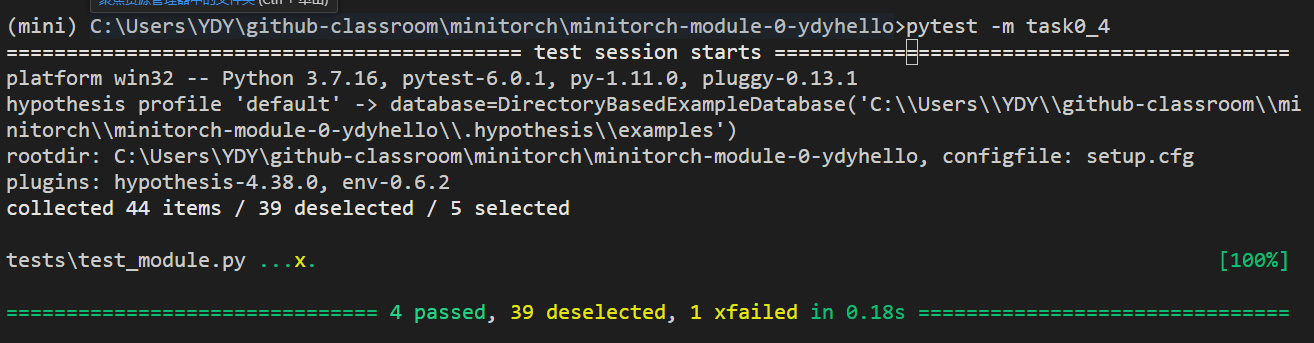
4.png

Task 0.4: Modules

1
2
3
4
5
6
7
8
9
10
11
12
13
14
15
16
17
18
19
20
21
22
23
24
25
26
27
28
29
30
31
32
33
34
35
36
37
38
39
40
41
42
43
44
45
46
47
48
49
50
51
52
def train(self):
# 将当前模块及其所有子模块切换到训练模式,以便在模型训练时使用
"Set the mode of this module and all descendent modules to `train`."
# TODO: Implement for Task 0.4.
self.training = True # 切换到训练模式
for child_ in self._modules:
self._modules[child_].train() # 对每个子模块调用 train 方法
# raise NotImplementedError('Need to implement for Task 0.4')

def eval(self):
# 评估模型
"Set the mode of this module and all descendent modules to `eval`."
# TODO: Implement for Task 0.4.
self.training = False
for child_ in self._modules:
self._modules[child_].eval()

def named_parameters(self):
# 收集当前模块及其所有子模块的参数
# 并以层次结构的方式返回参数的名称和对应的 Parameter 对象
"""
Collect all the parameters of this module and its descendents.

Returns:
list of pairs: Contains the name and :class:`Parameter` of each ancestor parameter.
"""
# TODO: Implement for Task 0.4.
res = [] # 存储参数的名称和 Parameter 对象
for k, v in self._parameters.items():
res.append((k, v)) # 参数的名称 k 和 Parameter 对象 v 添加到列表 res 中

for child_ in self._modules:
child_params = self._modules[child_].named_parameters() # 获取子模块及其子模块的参数列表
for item in child_params: # 将子模块的参数添加到 res 列表中
res.append((child_ + '.' + item[0], item[1]))

return res

# raise NotImplementedError('Need to implement for Task 0.4')

def parameters(self):
# 遍历当前模块及其所有子模块的参数,并以列表形式返回这些参数
"Enumerate over all the parameters of this module and its descendents."
# TODO: Implement for Task 0.4.
# 初始化为当前模块的 _parameters 字典中所有参数的值(Parameter 对象)构成的列表
res = list(self._parameters.values())

for child_ in self._modules:
child_params = self._modules[child_].parameters()
for item in child_params:
res.append(item)
return res

5.png

结果

6.png

提交到Github上编译测试点都能过,但是环境配置那里编译不过,奇怪。。。

module1

Overview

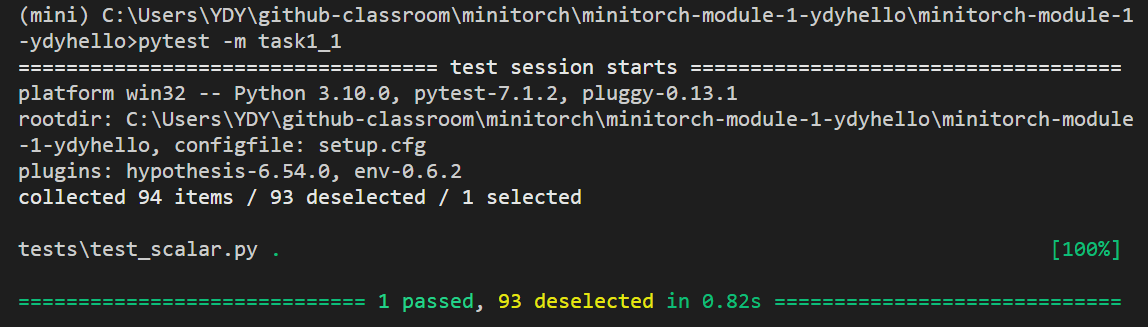
Task 1.1: Numerical Derivatives

1
2
3
4
5
6
7
8
9
10
11
12
13
14
15
16
17
18
19
20
21
22
def central_difference(f: Any, *vals: Any, arg: int = 0, epsilon: float = 1e-6) -> Any:
r"""
Computes an approximation to the derivative of `f` with respect to one arg.

See :doc:`derivative` or https://en.wikipedia.org/wiki/Finite_difference for more details.

Args:
f : arbitrary function from n-scalar args to one value
*vals : n-float values $x_0 \ldots x_{n-1}$
arg : the number $i$ of the arg to compute the derivative
epsilon : a small constant

Returns:
An approximation of $f'_i(x_0, \ldots, x_{n-1})$
"""

# TODO: Implement for Task 1.1.
my_vals = list(vals)
my_vals[arg] += epsilon
delta = f(*my_vals) - f(*vals)
return delta / epsilon
# raise NotImplementedError("Need to implement for Task 1.1")

7.png

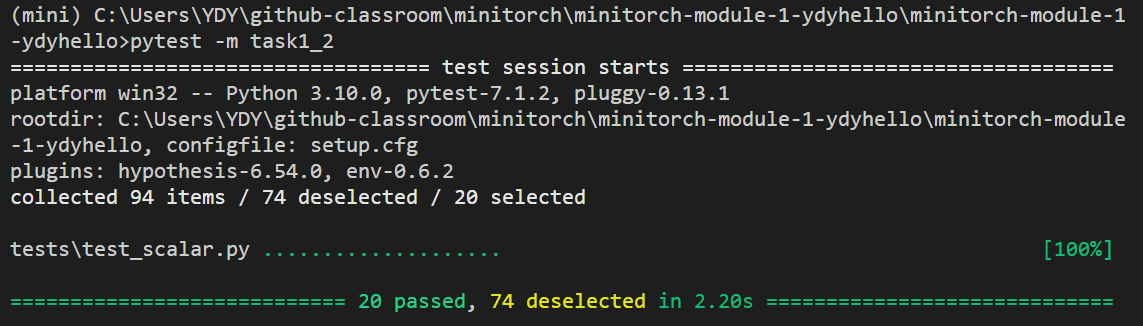
Task 1.2: Scalars

后面的代码和结果就不一一列举了

8.png

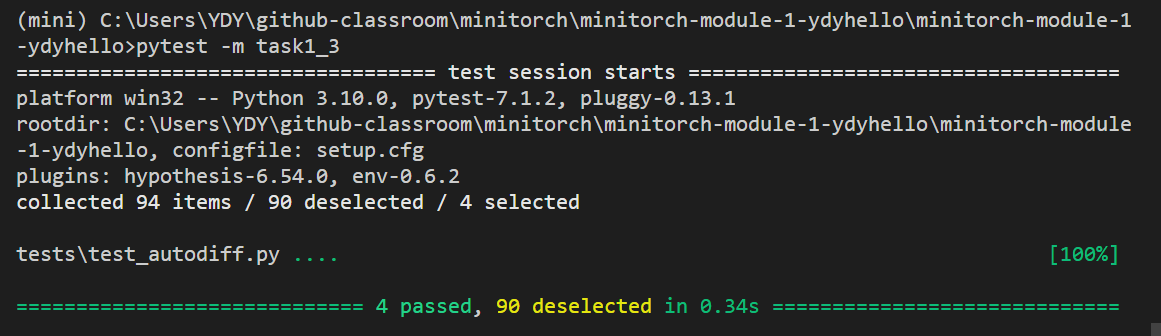
Task 1.3: Chain Rule

9.png

Task 1.4: Backpropagation

Task 1.5: Training

提交到Github上面编译测试点也都能过